

FAQ - Instructors
Instructors will receive a list of all courses scheduled for evaluation in which they are listed as the Teacher of Record (ToR). If you have any questions about which courses are scheduled for evaluation, please contact IR .
Please check the course evaluation schedule for the full list of dates.
You can access your electronic course evaluations by following one of the options below:
1. Login to the Course Evaluations website using your BearID and password.
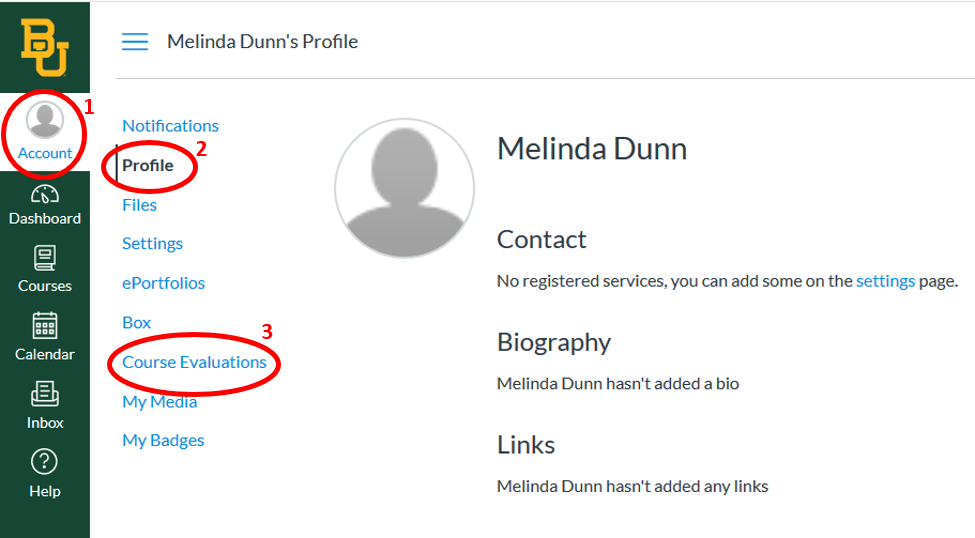
2. Login to Canvas using your BearID and password. Select "Account", "Profile", and "Course Evaluations" from the menu on the left side of the page.
We currently only offer the ability to add up to five additional items for all courses within the department. For more information regarding adding items, please contact IR.
Yes. One of the report options is ’Raw Data’ which is in Excel format. This file contains record level data for each respondent including comments, so you can match a student’s comments with how he/she answered the other questions. Please note that there is NO identifying information for any respondent, so you will not be able to identify which student submitted each response.
Results for all evaluations will be available after the deadline for grade submission each term. Instructors will be notified via e-mail when the reports are available.
See below for a short step-by-step illustration of how to log in and access your response rates and reports.
Accessing Course Evaluations - Instructors
Accessing Course Evaluations - Chairs
For more extensive information about reporting features, tutorials are available on the Watermark Course Evaluations and Surveys website.
Yes. You have the option to download the results for each course individually, or you can create a batch report to combine the results for each individual course into one PDF or .zip file. You can select the courses to include in the report by course number or instructor. See the "Accessing Course Evaluations" documents above for more information.
- Include the evaluation period (2-3 weeks before finals) in course syllabi.
- Remind students to check their Junk and Clutter folders for any Course Evaluation reminders.
- Ask students to be on the lookout for emails from course_evaluations@baylor.edu.
- Emphasize the significance of course evaluations and let students know that their responses matter.
- Monitor and communicate course response rates to students during class.
- Schedule time in a computer lab or during class when students can use laptops or tablets to complete electronic evaluations. Important note: Just as with paper evaluations, if class/lab time is set aside to complete evaluations, instructors must leave the classroom while students complete evaluations.
- During the evaluation period, give an assignment or exam through Canvas so that students are reminded to complete evaluations through pop-ups.
- Encourage students to use the single sign-on link: www.baylor.edu/course_evaluations.
- Provide incentives (for example, points toward a participation grade) for students who complete the evaluations. Or, if not for individual students, provide incentives for entire classes that receive a 100% response rate. Each student receives a confirmation email after he or she has completed each course evaluation. Students may print this confirmation email and share it with instructors as proof that they have completed the course evaluations. Or, the Office of Institutional Research can assist students with verification that evaluations have been completed.
- Have classes complete electronic evaluations at the beginning (as opposed to the end) of class. Instructors can show the overall response rate for an entire class through Canvas using an overhead projector and computer. Response rates are displayed in real time, so, as students complete evaluations, the rates go up. Some instructors have been successful by telling students that they will move forward with class once the response rate reaches 90-100% (depending upon absences). Note: Once again, in keeping with the University’s long-standing practice with course evaluations, faculty must leave the classroom while evaluations are being completed.
- Log in to the course evaluation system via https://www.baylor.edu/course_evaluations or Canvas with your bear ID and password.
- The response rate tracker box displays the response rate for all open course evaluations. Click the project name to drill down to course level response rates.
- To view final response rates, click "View All" on the response rate tracker widget. This will take you to a list of all available evaluation projects. The default only shows "in progress" course evaluation projects. Change the status drop down box to "ended". To narrow down the search results, enter the term and year (e.g. Fall 2019) in the project name search box and click search. Click the desired project to drill down to course level response rates.
- Tip: Course evaluation projects are listed in alphabetical order, not chronological.
At the beginning of each fall semester, a list of new courses and current comparison groups are sent to the department chair to review and update for the current academic year. Since the department chair knows the courses best, it is up to the Chair to determine the most suitable comparison groups for each course. If no comparison group is given by the department chair, the course is compared to itself. Comparison groups contain all sections of the courses denoted by the department chair for the last three years.
There is a box at the bottom of the last page titled Benchmark Course Codes. The Benchmark Course Unique IDs row lists all course codes in the comparison group. The Exclude Benchmark Course Unique IDs row contains a list of courses to omit from the comparison group. The Benchmark Start Date is the date the comparison group starts.
For example, if the Benchmark Course Unique IDs says BIO3*, this means the comparison group contains all sections of BIO courses with a course number beginning with a 3. However, if the Exclude Benchmark Course Unique IDs says BIO3100*, then the comparison group would include all BIO courses beginning with a 3 except for BIO3100 sections. Semester courses currently exclude trimester courses for the current term and vice versa due to term dates overlapping but ending at different times. This makes reporting more efficient for our office.